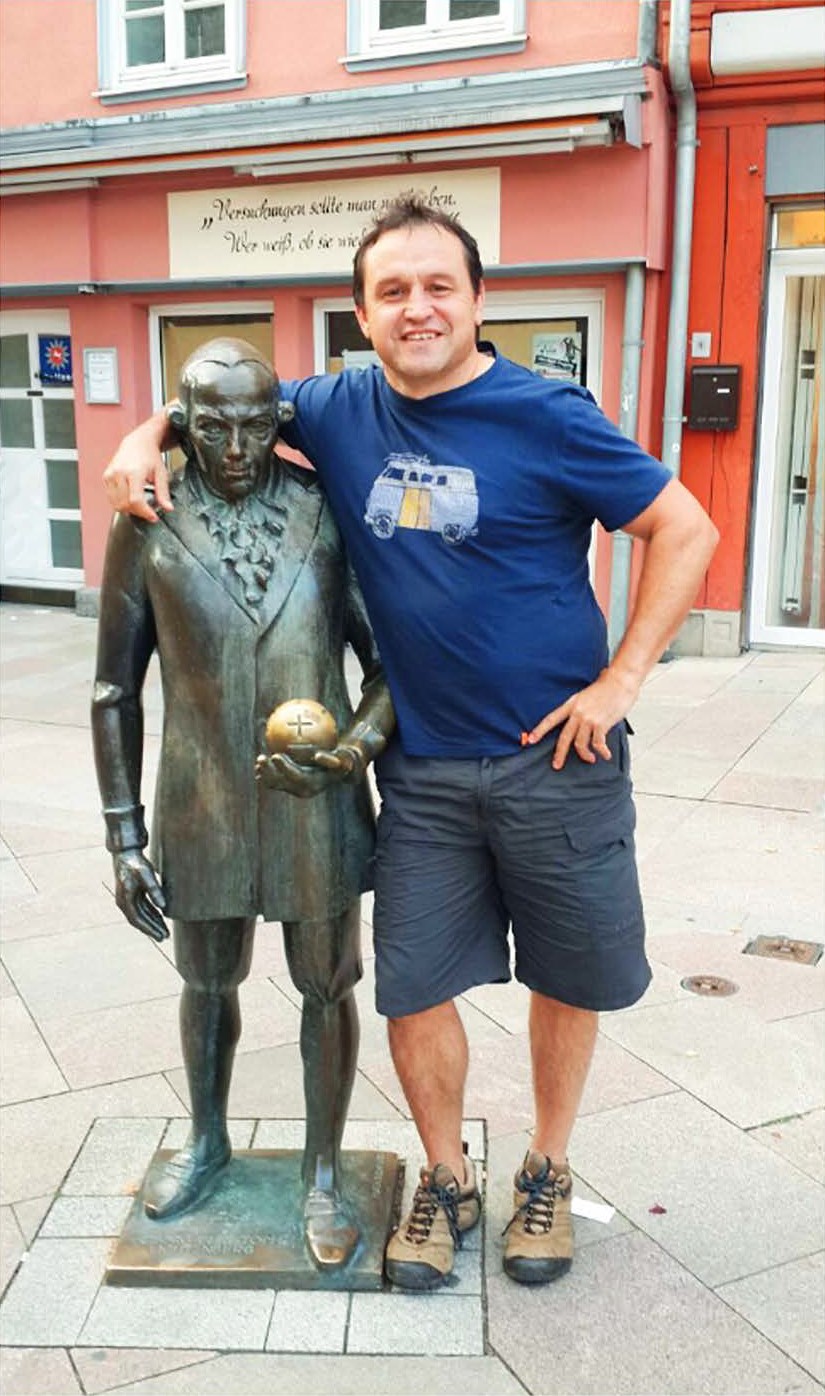
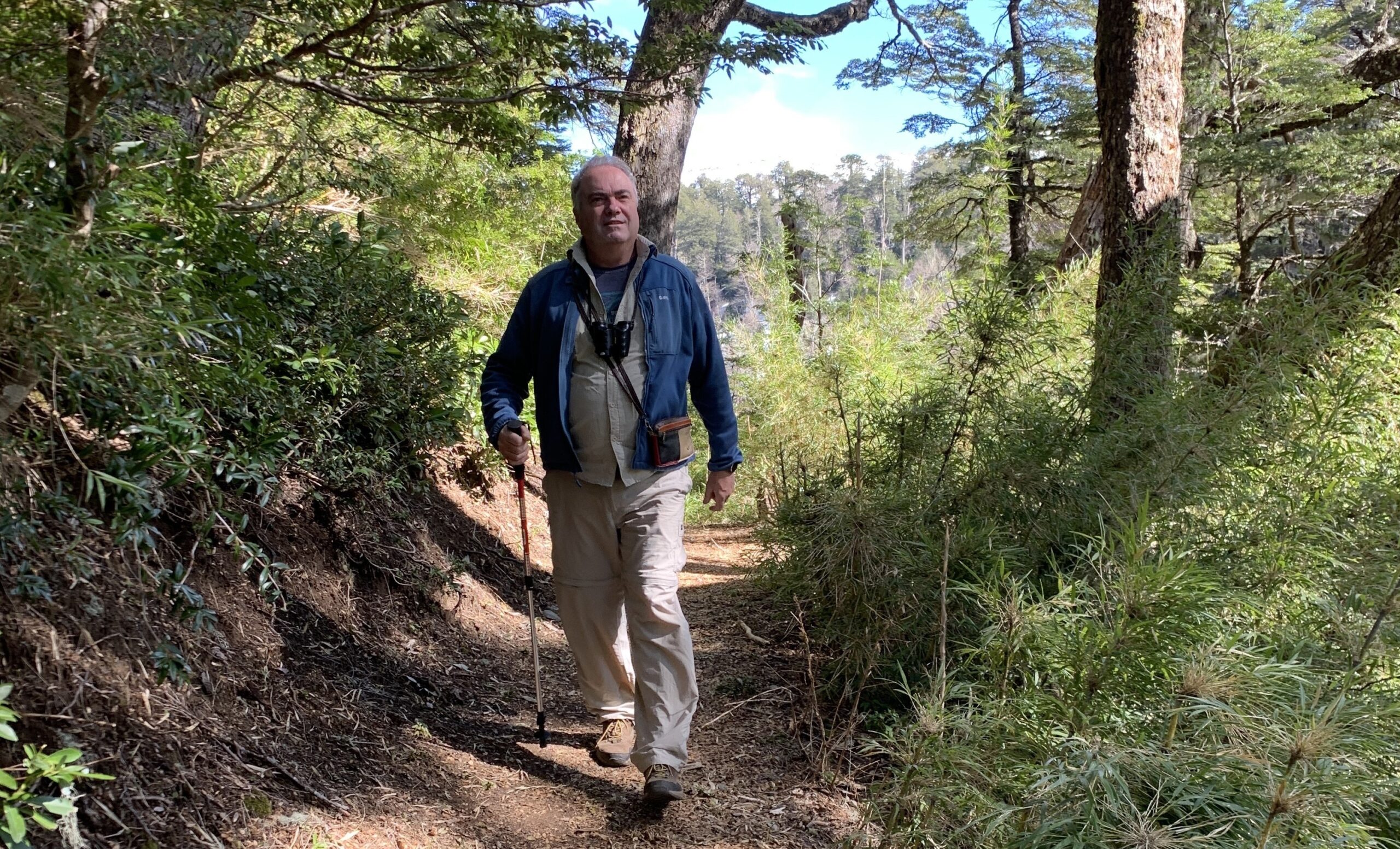
Prof Dave Richardson (photo: Engela Duvenhage).
The director’s baton of the DST/NRF Centre of Excellence for Invasion Biology (C·I·B) at Stellenbosch University was handed over from one
world-class scientist to another. Prof Dave Richardson took up this leadership role on 1 May 2012. This follows the resignation of the C·I·B’s
founding director, Prof Steven Chown, who is to pursue his academic career further in Australia.
“The Centre has been extremely lucky to have had two A rated researchers working side by side for the past few years, and this has helped us to make an internal
appointment of extremely high calibre,” says Prof Eugene Cloete, dean of the Faculty of Science and a member of the C·I·B Board.
Prof Richardson has been the C·I·B’s deputy director: science strategy since 2005 and has, along with Prof Chown, played a leading role in establishing
the Centre’s reputation as an internationally recognised and most prolific research entity. The centre aims to deliver the science and research required to reduce the introduction rate
and impact of invasive species.
Prof Richardson, a prolific author and invasive tree specialist, will receive the Herschel Medal from the Royal Society of South Africa in September, which honours his
multidisciplinary contribution to science through his internationally recognised work on the ecology and management of invasive species. Although plants are his primary focus, he has
also recently helped to develop risk-assessment protocols for introduced reptiles and amphibians. Prof Richardson also publishes, lectures and consults widely on issues such as invasive
species in commercial forestry and agroforestry, the risks associated with using introduced plants in the production of biofuels, and managed relocation.
He is also the recipient of the international Hans Sigrist Prize (2006), a National Science and Technology Forum award (2008), and a Rector’s Award for Excellence in
Research from Stellenbosch University (2007). Prof Richardson received an A1 rating from the National Research Foundation (NRF) in 2007, which recognises his international stature as
a scientist.
One DSc student, sixteen masters and five doctoral students have already graduated under his supervision.
He was elected a fellow of the Royal Society of South Africa in 2008 and a member of the Academy of Science of South Africa in 2009. He serves on several international
committees, including three IUCN (World Conservation Union) Species Survival Commission specialists groups, and has been editor-in-chief of the journal Diversity and Distributions
since 1998. He is the editor of the widely acclaimed book Fifty years of Invasion Ecology.
Prof Chown will take up his new position as head of the School of Biological Sciences at Monash University in Melbourne, Australia, in July where he hopes to pursue research
questions that he has been considering since the 1990s.
He says the diversity of knowledge, life and approaches which are part of the culture of the C·I·B were what inspired him most at the Centre. He will stay on as
an extraordinary professor at Stellenbosch University to supervise his remaining postgraduate students.
His research interests span a broad range of topics, as he believes that an understanding of the processes underlying global patterns in the distribution of biodiversity can
only be achieved by an integration of disciplines. He is engaged in biogeographic and macroecological studies, macrophysiology, spatial ecology, invasion biology and the integration of these
fields. He is also engaged in conveying the policy implications of environmental change research to a broader audience.
This A1 rated scientist is, among others, the recipient of the international Martha T Muse Award for Science and Policy in Antarctica, the Gold Medal of the Zoological Society
of Southern Africa, and the Bill Venter/Altron Literary Award.
He was the driving force behind the establishment of the C·I·B in 2004, one of eight Centres of Excellence in South Africa being funded by the Department of
Science and Technology and the National Research Foundation. The C·I·B has since expanded to include four full-time academic staff, sixteen non-academic staff, and eleven
students and postdoctoral fellows at the Centre’s hub at Stellenbosch University. A further seventeen academic core team members and about fifty students and postdoctoral researchers are
based at other universities around South Africa.
The C·I·B investigates, among others, the influence of climate change on the spread of invasive species and animals that carry diseases. During his tenure as
director, Prof Chown also motivated the establishment of the Antarctic Legacy Project, a digital archive of South Africa’s involvement in Antarctica and Sub-Antarctica, as well as the
successful Iimbovane Outreach Programme to schools in the Western Cape.
Released by: Engela Duvenage, Media: Faculty of Science, Stellenbosch University
(021) 808 2684 science@sun.ac.za 082 874 1291